


Practice Vantage: check the suburb before you sign for it
A free tool that reads any Australian catchment in about thirty seconds: the practices already there, the people they serve and where the gaps are. What it shows, how to read it, and when to use it.
The short answer
Almost every decision on a clinical fitout is made after the suburb has been chosen, and the suburb is usually chosen on instinct: near home, near the old job, a shop that happened to be empty. The fitout industry, us included, only turns up once the lease is signed. Practice Vantage is our attempt to be useful one step earlier. It reads any Australian suburb for any clinical discipline and tells you who is already practising there, how many people they share, and where a new practice could realistically fit. It is free, it needs no account, and a read takes about thirty seconds.
Key points
- Type a suburb or a street address and a discipline; a read takes about thirty seconds and needs no account.
- Every practice Google lists inside the circle, ranked by how hard it would be to take patients from.
- Who lives there from the ABS: population and its growth, age, long-term health conditions, language.
- A verdict from Open to Contested, and the specific openings and headwinds behind it.
- It is the step before a site assessment, not a replacement for one.
Almost every decision on a clinical fitout is made after the suburb has been chosen, and the suburb is usually chosen on instinct: near home, near the old job, a shop that happened to be empty. The fitout industry, us included, only turns up once the lease is signed. Practice Vantage is our attempt to be useful one step earlier. It reads any Australian suburb for any clinical discipline and tells you who is already practising there, how many people they share, and where a new practice could realistically fit. It is free, it needs no account, and a read takes about thirty seconds.
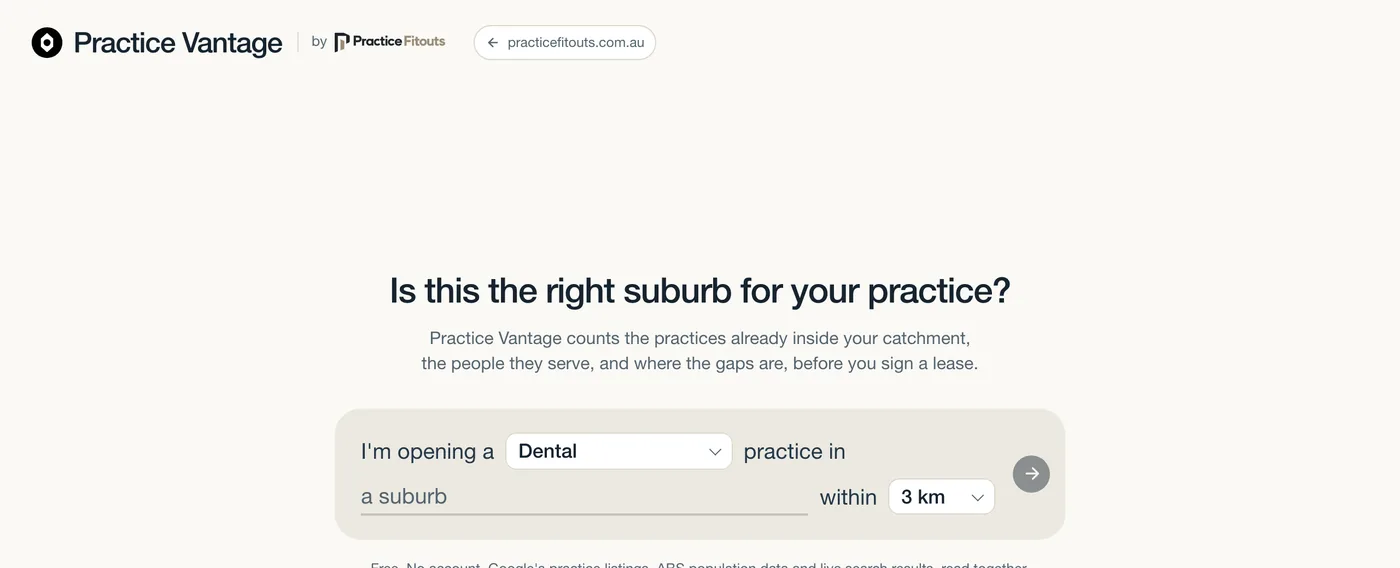
If you already have a tenancy in mind, type its street address instead of the suburb. The circle is then drawn from the front door rather than from wherever the map puts the suburb’s centre, which is the difference between a rough read and a useful one when the radius is a kilometre or two.
Why we built it
We look at a lot of tenancies before they are signed, and the expensive mistakes are rarely about the building. They are about the catchment. A practice opens 400 metres from three well-reviewed competitors because nobody counted them; a second location goes into a suburb whose population is flat and ageing because nobody checked. The information to avoid both was public the whole time, spread across Google Maps and the Census, and nobody had put it in one place for someone about to commit two hundred thousand dollars to a fitout.
So we built the tool we wished our clients had used before they called us. It reads the two sources any practice owner would read if they had a spare weekend, Google’s listings and the ABS, and does the counting.
What a read shows
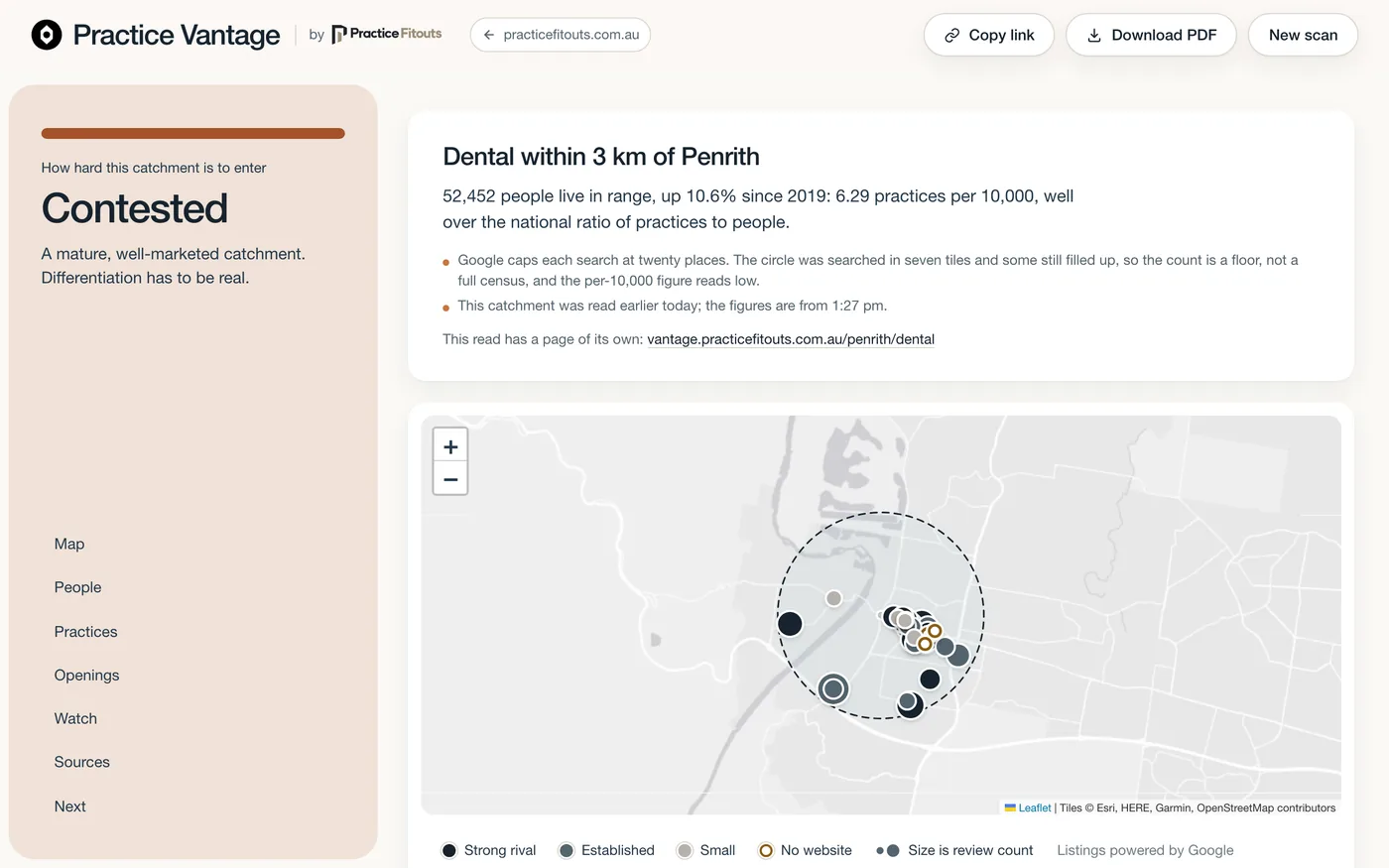
A read has four parts, in the order you would ask the questions yourself. The examples below are a real read: dental, within 3 km of Penrith in western Sydney.
The verdict
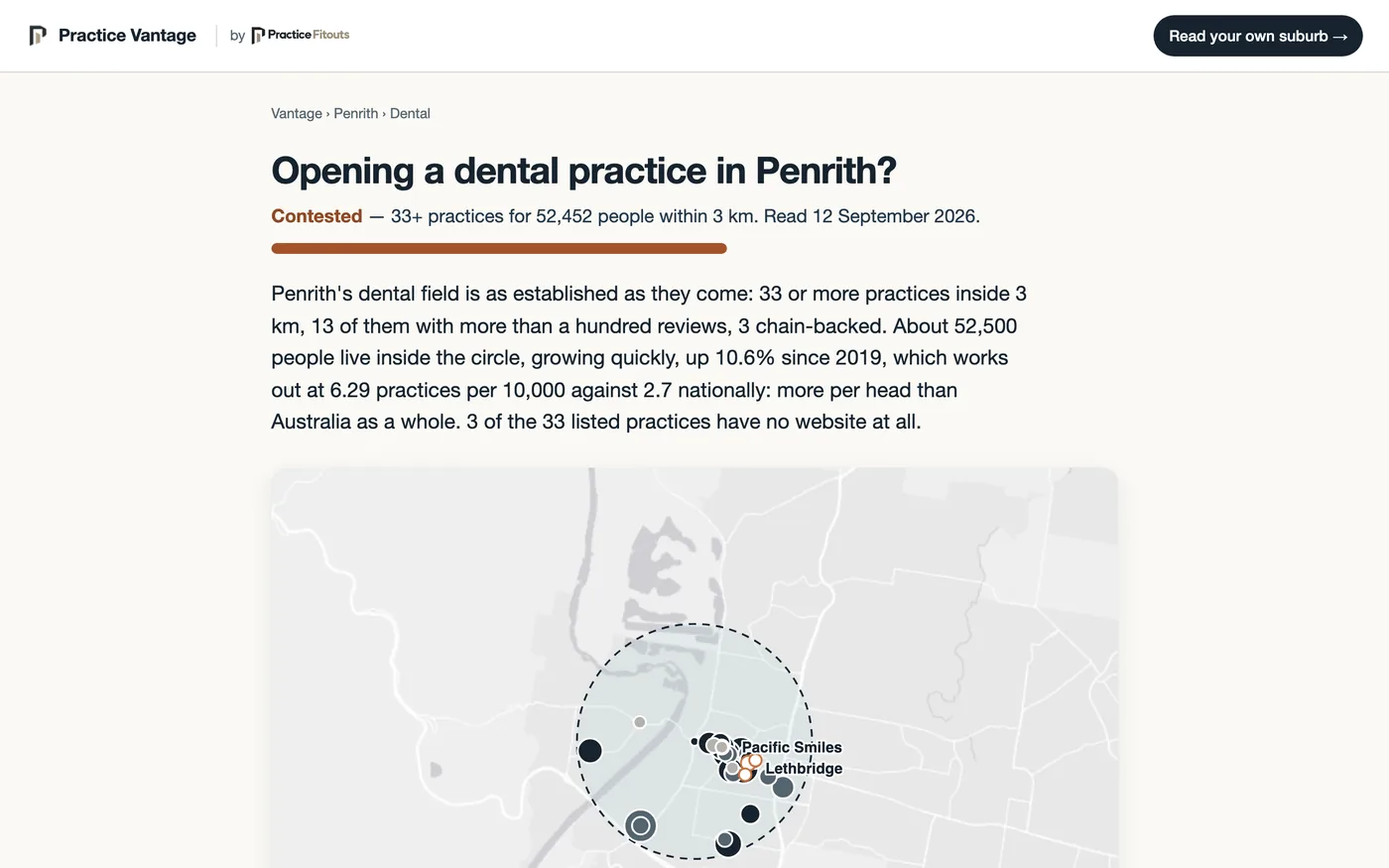
The first thing on the page is a single word for how hard the catchment is to enter, from Open through Moderate and Competitive to Contested, with the sentence that earns it. Penrith dental is Contested: 33 or more practices for 52,000 people, which is 6.3 practices per 10,000 against about 2.7 nationally. The verdict is not a recommendation. Contested catchments produce excellent practices every year; the word tells you that differentiation will have to be real, not that you should not try.
The map
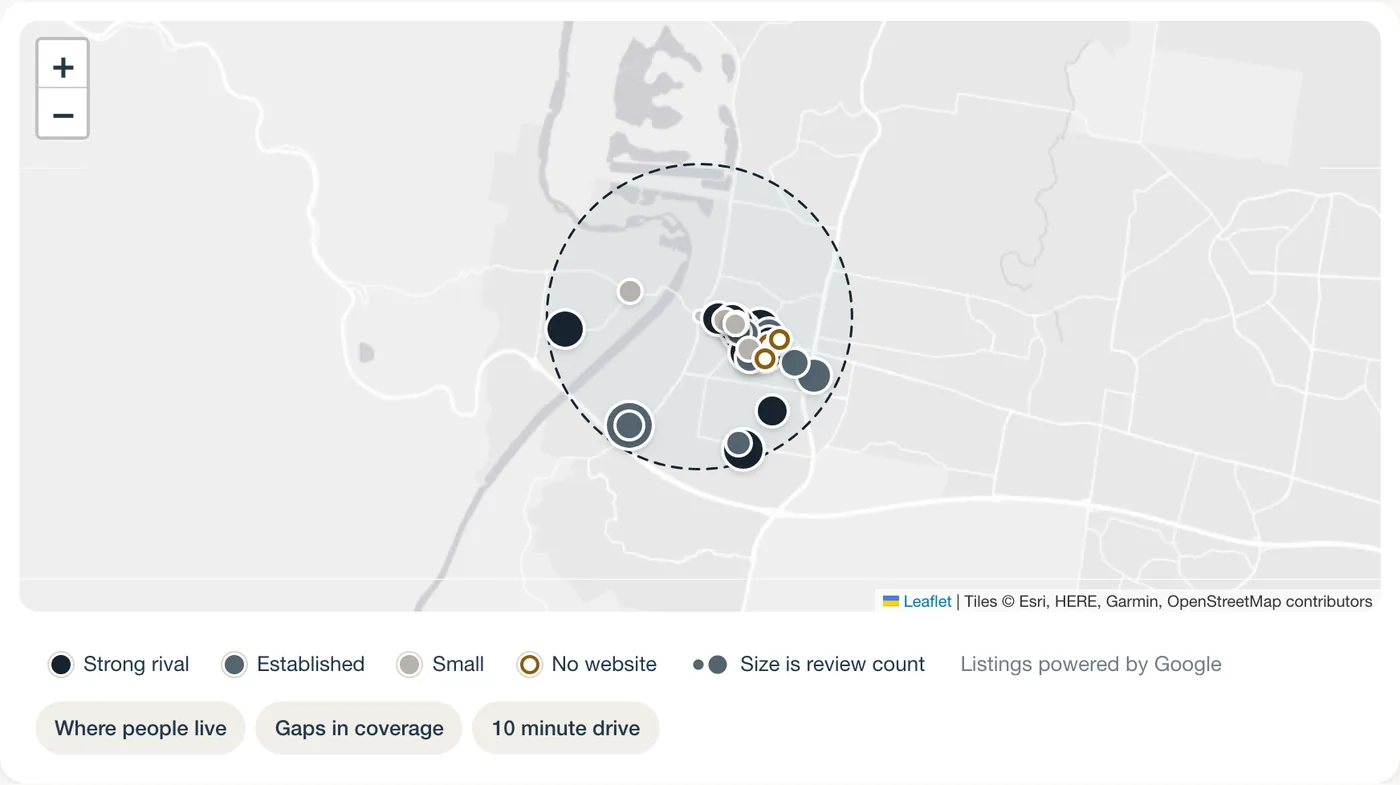
Every practice Google lists inside the circle, drawn where it actually sits. The size of each dot is its review count, the shade is how strong a rival it is, and a ring instead of a dot means the practice has no website at all. You can see clustering at a glance: in Penrith the dental practices sit almost entirely on the high street and the station side, and the western half of the circle is nearly empty. That is the kind of thing a list cannot tell you.
Who lives here
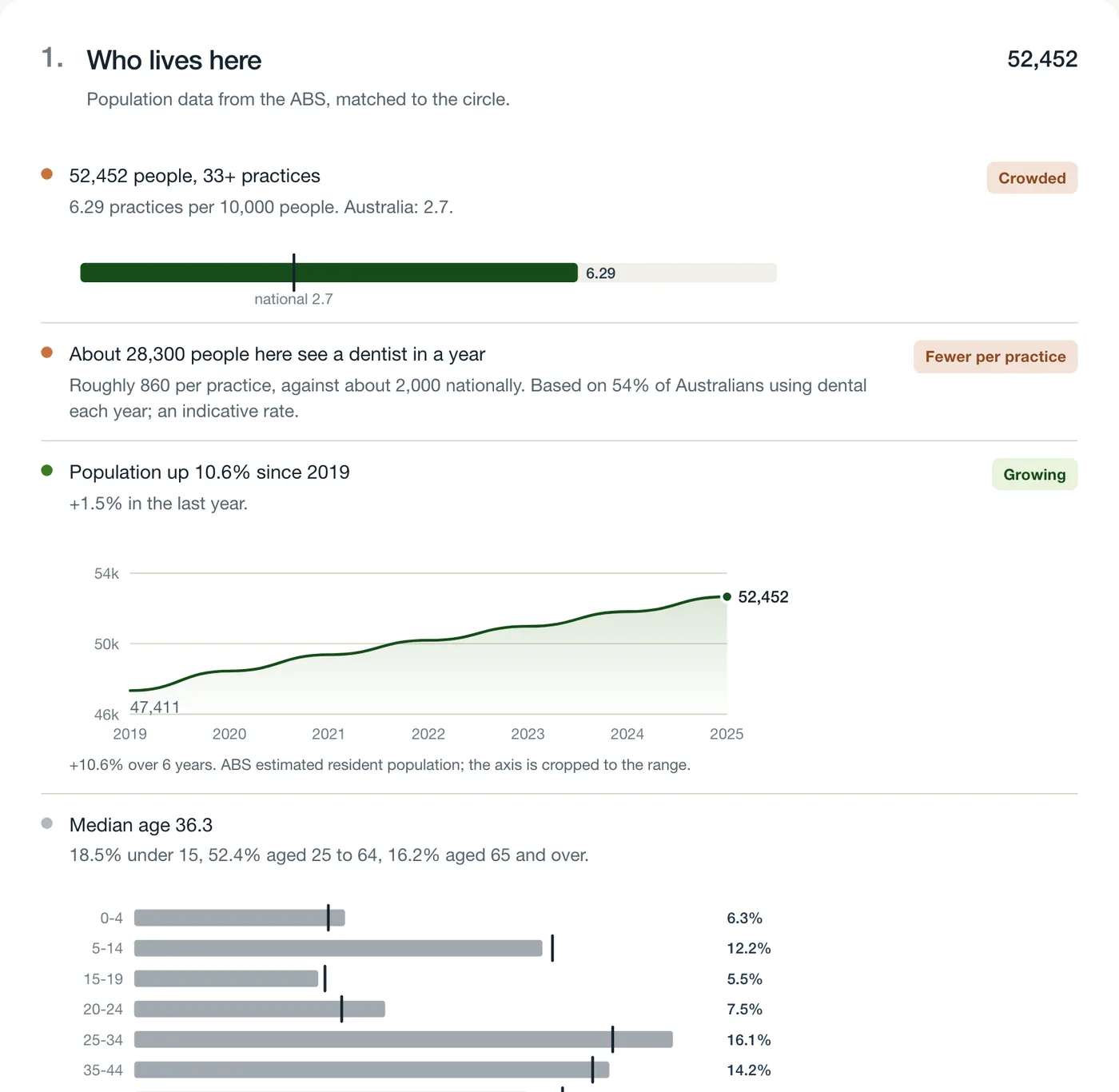
This is the half most people skip, and the half that decides whether a catchment can support one more practice. Vantage matches ABS data to the circle, weighting each statistical area by how much of it falls inside, and reports the population, its growth since 2019, the age profile against Australia, the share reporting each long-term health condition, and the share speaking a language other than English at home. Each figure is read for the discipline: a physiotherapist cares about the over-65s and arthritis, a paediatric dentist about the under-15s, a psychologist about the mental health line.
Penrith is instructive. The practice count says crowded, but the population is up 10.6% in six years and still rising, which is why the read says fewer patients per practice than the national figure rather than no room. Both things are true, and you need both.
Who is already there
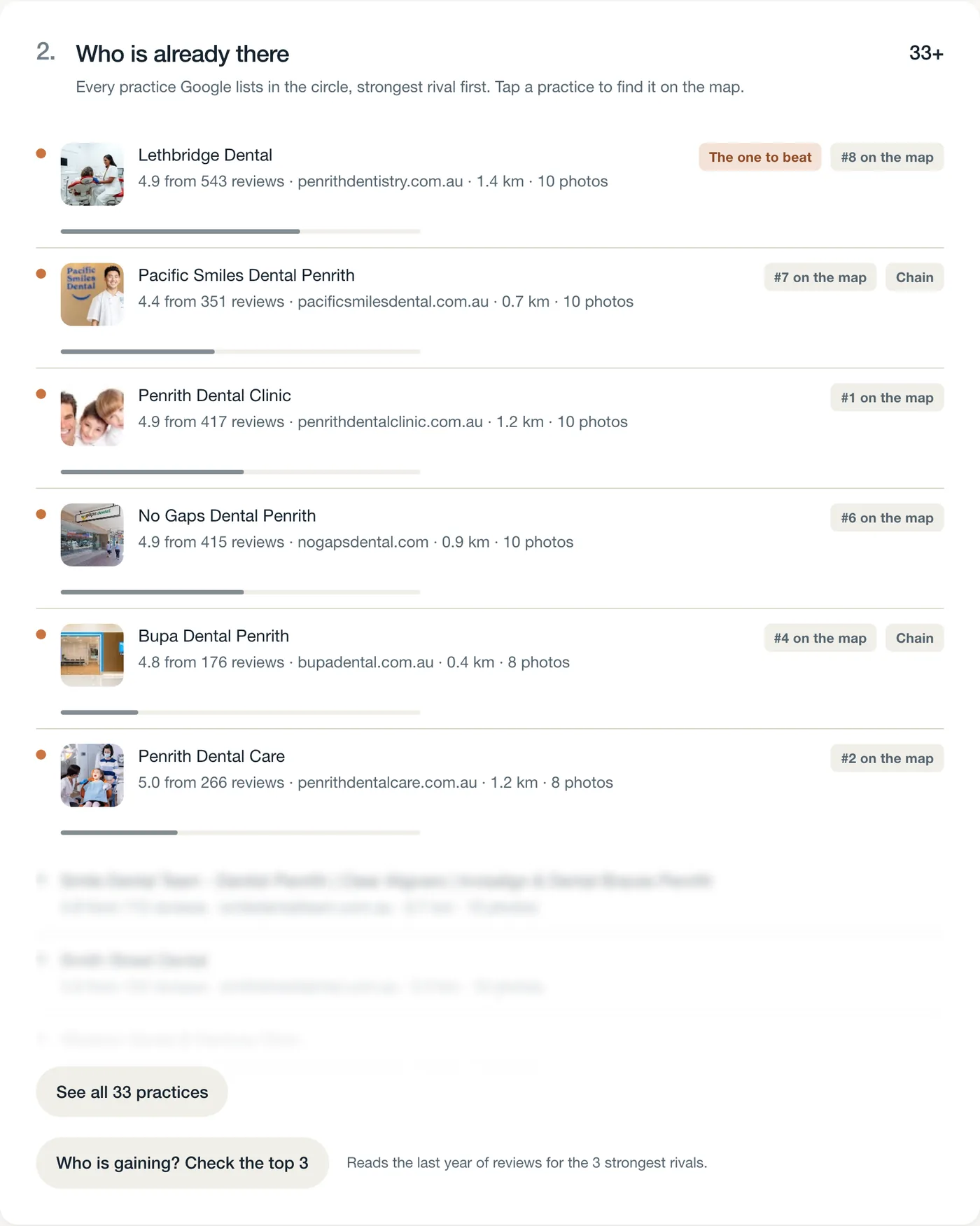
The practices, strongest rival first. Strength is a blend of rating, review count, whether the practice has a website and photos, and whether it is chain-backed. The one to beat is called out, each practice is numbered so you can find it on the map, and the top five are shown in full. The rest of the list, along with a check on who is gaining reviews fastest, sits behind a short form: a name, a practice and an email, once.
Where the openings are
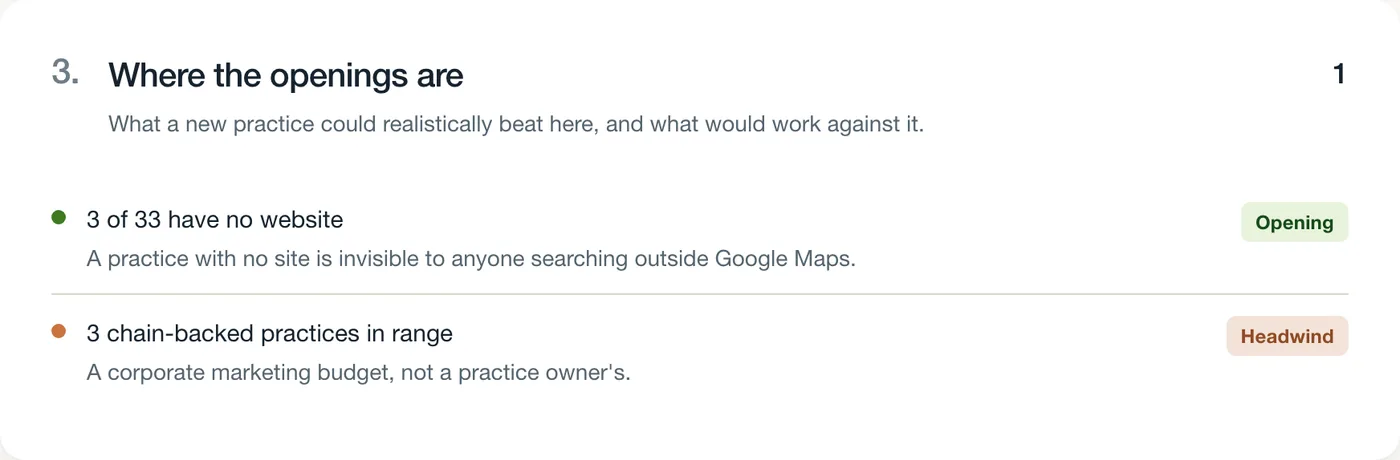
The last section turns the counting into something a business plan can use: what a new practice could realistically beat here, and what would work against it. In Penrith, three of the 33 practices have no website, which is an opening for anyone who invests in being found; three are chain-backed, which is a headwind. In a suburb with an older population and no practice open on Saturdays, the openings read differently. The point is that they are specific to the circle you drew.
When to use it
Shortlisting suburbs. The obvious one. Read four or five candidates on the same discipline and radius and the shortlist usually writes itself. Two contested catchments and one moderate one with a growing population is a decision, not a debate.
Choosing a second location. Owners expanding tend to pick the suburb they know rather than the suburb that needs them. A read of each takes a minute and removes the guesswork, and a growing suburb with an older profile than your first one may want a different room mix, which is a fitout conversation worth having before the lease.
Buying an existing practice. The vendor’s figures tell you what the practice earned; the read tells you what the catchment can still give it. Population growth, the strength of the three nearest rivals and how fast they are gaining reviews are the questions a valuation rarely answers. Our guide to buying a practice’s premises covers the building side.
The bank and the business plan. Lenders ask about the catchment before they ask about the finishes. A read is a page of sourced numbers on population, demand and competition, and it can be downloaded as a PDF or shared as a link to the suburb’s own page.
Negotiating a lease. A landlord with an empty shop in a suburb that already has eleven physiotherapists is not offering you a prize. Knowing that changes the conversation about incentives and rent-free periods. See lease incentives and fitout contributions.
Watching a catchment. If you are not ready to move, you can watch a circle instead and be told when a new practice opens inside it. Timing a second location to a competitor closing is easier when you notice.
Suburb pages
Every read that comes back with a real place behind it is published as a page of its own, at an address like vantage.practicefitouts.com.au/penrith/dental. The page is written in plain prose from the numbers, carries the map and the top five practices, and links to the other disciplines read in the same suburb and the same discipline in suburbs nearby. It is refreshed every month while people keep reading it. If you want to send a read to a business partner or a lender, that is the link to send.
What it cannot tell you
Vantage is honest about its limits on the page, and it is worth being honest here too. Google caps each search at twenty places, so in a dense catchment the count is a floor, not a census; the read says so when it happens. Review counts measure marketing effort as much as clinical quality. The population figures are estimates for statistical areas, weighted into your circle, not a head count. It does not know rents, referral patterns, whether the practice on the corner is about to retire, or anything about the building. That last part is what a site assessment is for, and it is the reason we built the tool: so that by the time you are asking us about the shell, the suburb is already settled.
Where it lives
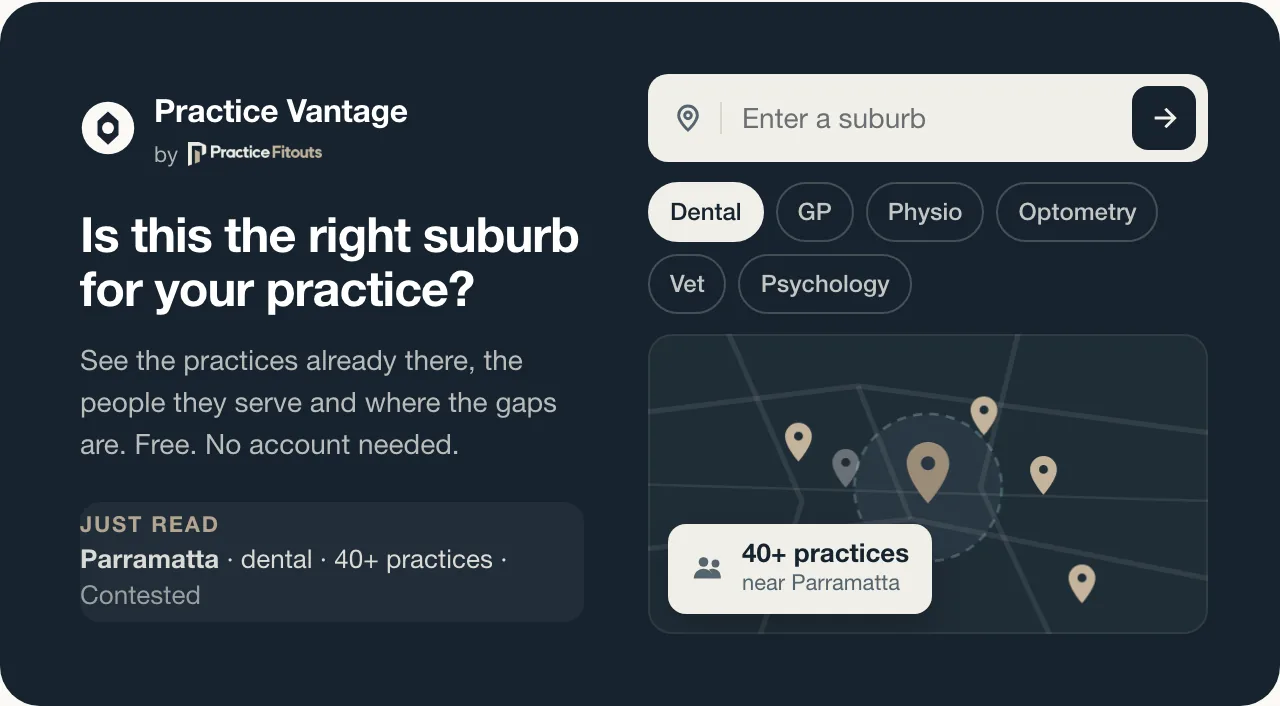
The tool is at vantage.practicefitouts.com.au. There is also a small version of it in the Sectors menu at the top of every page on this site: type a suburb, pick a discipline, and you land in the read.
Sources and privacy
Practice listings come from the Google Places API and are refreshed rather than stored beyond Google’s terms. Population, age, language and health conditions come from the ABS: estimated resident population for 2019 to 2025, and the 2021 Census. Demand rates use the ABS Patient Experiences survey. Every read lists its sources at the bottom with links. A read itself needs no account and no email. The extras, the full practice list, the review velocity check, the PDF and the compare view, ask for a name, a practice and an email once, and that is the only data we keep.
Sources and further reading
Practice Vantage reads Google’s practice listings and ABS population, Census and Patient Experiences data for the circle you draw. Every read lists its own sources with links.
Text search and Place Details. The practice listings, ratings, review counts and websites Practice Vantage reads for a catchment.
Building activity and construction cost data, useful for sanity-checking where trade pricing is heading.
Patient Experiences 2024-25. The share of Australians who saw a GP, a dental professional or a mental health professional in the last twelve months.
Questions
Is Practice Vantage free?
Yes. A read needs no account and no email. The full practice list, the review-velocity check, the PDF and the compare view ask for your name, practice and email once.
Which disciplines does it cover?
Dental, general practice, physiotherapy, chiropractic, podiatry, optometry, veterinary, psychology and exercise physiology. Each has its own search and its own demand rate.
How accurate is the practice count?
It is every practice Google lists inside the circle, searched in tiles to get past Google’s twenty-place cap. In a dense catchment some tiles still fill up, and the read says so; treat the count as a floor.
Where does the population data come from?
The Australian Bureau of Statistics: estimated resident population by statistical area for 2019 to 2025, and the 2021 Census for age, language, birthplace and long-term health conditions. Each area is weighted by how much of it sits inside your circle.
Can I share a read?
Yes. Every read with a real suburb behind it is published as a page at vantage.practicefitouts.com.au, and Copy link gives you that address. The PDF is the same read, laid out to print.
Does a good read mean I should open there?
No. It means the catchment can support another practice on the numbers. The building, the lease, the approvals and your own referral network still decide whether this tenancy is the one, and that is what a site assessment is for.
Send us the floor plan
A site assessment tells you what the tenancy can take and what it will cost to get there, ideally before you have signed for it.