


Warm shell or cold shell?
Two words in a lease that decide more of your budget than every finish you will ever choose.
Indicative fitout costs published. No form required. See the numbers
Is this the right suburb for your practice? Check it free. Practice Vantage
We look at tenancies before you sign, not after. Site assessments
Twenty-three guides for people about to commit money to a tenancy, in the order a project actually meets them.
Numbers where we have them, the reasoning behind them, and the parts other people leave out. If you want the reasoning behind publishing any of it, it is on the about page.
A free tool that reads any Australian catchment in about thirty seconds: the practices already there, the people they serve and where the gaps are. What it shows, how to read it, and when to use it.
9 min read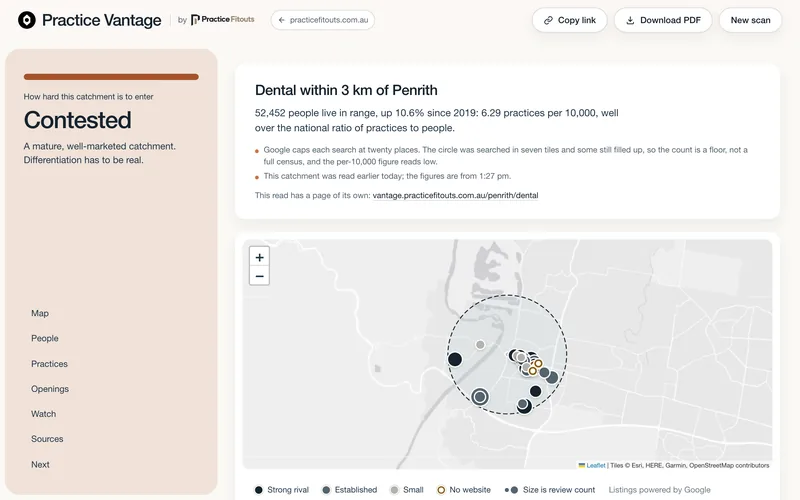
Two words in a lease that decide more of your budget than every finish you will ever choose.
5 min readIndicative ranges per square metre for all four sectors, with inclusions and exclusions.
CostsThe access standard that rules more tenancies out than any other, and what it actually asks for.
9 min readWhat to establish about a tenancy while walking away is still free.
Two words in a lease that decide more of your budget than every finish you will ever choose.
Construction is the short half. Here is where the rest of the time actually goes.
The clause nobody reads until the last year of the lease, and the one that decides whether you leave with money or write a cheque on the way out.
Rent-free periods, cash contributions and landlord works are not the same thing, and they are not worth the same to you.
The accountant reads the numbers and the lawyer reads the contract. Between them sits a tenancy nobody has assessed, and it is the part you cannot renegotiate later.
Everything that has to be true before you can see a patient, in the order it has to happen, and which items sit on the critical path.
A free tool that reads any Australian catchment in about thirty seconds: the practices already there, the people they serve and where the gaps are. What it shows, how to read it, and when to use it.
What goes in a business plan for a new medical, dental or allied health practice, in the order a bank reads it: the catchment, the capital budget, the revenue model, the break-even, and the risks you name before they do.
The Australian systems for general practice, dental, allied health and veterinary, cloud against a server in the cupboard, what each choice costs, and the cabling, power and room decisions that have to be made before the walls close.
What the work costs per square metre, and what moves the number.
Per square metre, what sits inside that figure, and the four things that move it more than finishes do.
Rates for general practice, specialist rooms and day procedure, and why the three are not comparable.
The job at the end of a lease, or the one before a new fitout starts. Priced badly more often than any other trade package.
The fitout is roughly half of it. Here is the whole number, including the parts that surprise people in the last month before opening.
Four ways the money usually arrives, what each costs you in control, and the question a lender will ask that most applicants have not thought about.
The certificates between a signed lease and an open practice.
Usually. Here is how the approval works in New South Wales, Victoria and Queensland, and why it’s the part of the program that moves your opening date.
The fast lane through NSW planning, when your tenancy qualifies. And the trap of assuming it does.
What it is, when you need one, who issues it, and why it isn’t the approval most people think it is.
Occupancy certificate, occupation certificate, occupancy permit. One document, six names, and the last thing standing between a finished fitout and a working practice.
Two separate approvals from two different people, in a fixed order. Most delays in a Melbourne fitout come from treating them as one thing.
Material change of use, four levels of assessment, and a planning scheme that decides all of it before you have drawn a room.
Sometimes, and the answer turns on a definition rather than on the building. Here is what the planning system actually permits.
The standards that decide whether your practice can open and stay accredited.
Accreditation is mostly about how you run a practice. A handful of it’s about the rooms, and that handful is expensive to retrofit.
One direction of travel, no crossing back. Everything else in the room follows from that.
The access standard that rules more tenancies out than any other, and what it actually asks for.
Not the same thing as an accessible toilet, triggered by different rules, and routinely left out of a fitout until the certifier asks.
Every building in Australia sits in a class, the class sets the rules, and changing use changes the class.
The health-care classification, what triggers it, and why it should be settled before you sign a lease rather than during documentation.
Why the base building air conditioning that suits an office frequently cannot serve a clinic, and what to check before you sign.
What they’re, when a clinic actually needs one, and why they are engineered rather than specified.
Evacuation diagrams, wardens and the obligations that start the day you occupy, not the day you build.
Two reprocessing standards, two very different rooms. Practices routinely design to the wrong one and find out during accreditation.
What an FRL actually means, which walls need one, and why the cheapest way to fail an inspection is a hole somebody drilled after the wall was signed off.
A clinical practice is a high hazard connection to the town water main. That single classification sets the device, the space it needs and an annual testing obligation.
The gradients, the landings and the reason a ramp that looks fine gets rejected. Access is what rules out the most tenancies, and it is decided at the front door.
How much light a consulting room actually needs, why the number on the design is higher than the number in the standard, and the two things that matter more than lux.
How the rooms themselves get set out.
Noise, separation, drainage and the small rooms that owners wish they had planned for.
The room itself: where the chair goes, what reaches it, and the decisions that are fixed the day the slab is cut.
The arithmetic that decides whether a tenancy works, done before you sign rather than after the architect has been paid.
Drop tables and dropped weights send sound through the structure, not the air. It is the one acoustic problem that cannot be fixed from the other side.
How a general practice or medical centre is set out: the patient path, consulting room sizes, the waiting room, treatment and reprocessing, staff space, and the standards that decide most of it.
The vocabulary in a building contract, and where it costs you.
The line in a building contract that makes a cheap quote look cheap.
Not when the building is perfect. When it’s usable, with a list attached.
Twelve months in which things that only show up in use get fixed, and the retention that makes it happen.
One contract with one party accountable, or two with a competitive price. On a clinical fitout the answer leans one way more than people expect.
The three mechanisms that move money on a fitout, and the three places a practice owner loses control of the budget without noticing.
Four questions and a number that moves as you change them. Nothing gets sent anywhere.
EstimatorCount the rooms you want. It adds the support spaces and the circulation.
Space plannerWarm shell, make good, Class 9a, provisional sum. The words that turn up in a lease or a contract.
GlossaryA site assessment tells you what the tenancy can take and what it will cost to get there, ideally before you have signed for it.