


A medical practice business plan: the numbers a lender actually reads
What goes in a business plan for a new medical, dental or allied health practice, in the order a bank reads it: the catchment, the capital budget, the revenue model, the break-even, and the risks you name before they do.
The short answer
A business plan for a practice is read by two people: a lender, and you in eighteen months when the numbers are real. Both want the same things and neither wants the forty-page template most accountants hand out. A lender wants to know that the catchment can support the practice, that the capital budget is complete, that the revenue model is arithmetic rather than hope, and that you have thought about what goes wrong. This guide is built in that order, with the Australian sources and tools to fill each part, and it applies to general practice, dental, allied health and veterinary with the figures changed.
Key points
- A lender reads the catchment, the capital budget and the break-even; the rest is context.
- Show where patients come from with data, not a paragraph: population, competing practices, referrers.
- The capital budget has nine lines. Equipment and contingency are the two most often missing.
- Model revenue per room per session, not per practice, and show the ramp over the first year.
- Working capital for three to six months is the line that decides whether the loan is enough.
A business plan for a practice is read by two people: a lender, and you in eighteen months when the numbers are real. Both want the same things and neither wants the forty-page template most accountants hand out. A lender wants to know that the catchment can support the practice, that the capital budget is complete, that the revenue model is arithmetic rather than hope, and that you have thought about what goes wrong. This guide is built in that order, with the Australian sources and tools to fill each part, and it applies to general practice, dental, allied health and veterinary with the figures changed.
Who reads it and what they are looking for
The specialist lenders (Medfin, BOQ Specialist, Credabl, and the health desks at the major banks) lend to registered health professionals on terms the general business market does not get: higher loan-to-value ratios, lending against goodwill and equipment rather than a house, and start-up loans without trading history. In exchange they assess the plan harder than a generalist would, because they have seen a thousand of them. Their questions, in the order they ask them:
- Where is it, and can the suburb support another practice?
- What does it cost to open, all in, and is there a contingency?
- What does a room earn per session, how many sessions, and how fast does it fill?
- When does it break even, and what funds the practice until then?
- What is the lease, what is the make-good, and who is personally guaranteeing what?
- What happens if the lead clinician is unwell for three months?
A plan that answers those six on the first two pages will be read. One that opens with a mission statement will be skimmed.
1. The catchment
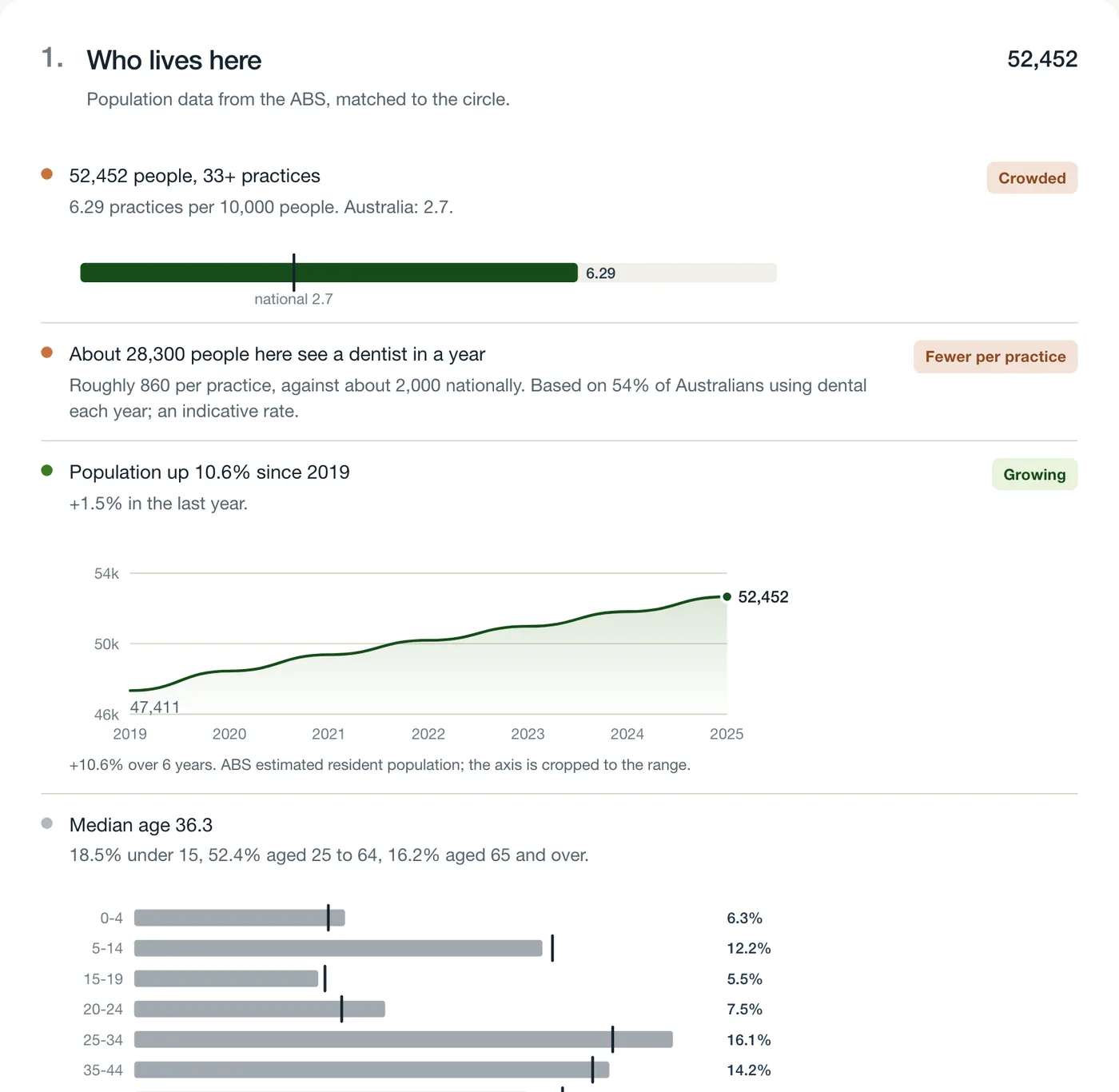
This is the section most plans get wrong, because they describe the suburb instead of measuring it. The measurement a lender wants is simple: how many people live within a realistic travel time, how many practices of your kind already serve them, whether the population is growing, and whether its profile fits your discipline. Every one of those is public. The ABS publishes estimated resident population by statistical area every year and the Census every five; Google lists every practice with its reviews and location; the ABS Patient Experiences survey gives the share of Australians who see a GP, dentist or mental health professional each year.
Practice Vantage reads all of that for any suburb or address in about thirty seconds and publishes the read as a page with the sources attached, which is the format a lender can check. Put the page link, the map and the four headline numbers in the plan: people in range, practices per 10,000 against the national figure, population growth since 2019, and the discipline-specific demand rate. Add the referral sources the read finds (the GP clinics near a physio, the schools near a dentist). A paragraph that says the suburb is growing and under-served is a claim; those four numbers are evidence.
2. The capital budget
Lenders see fitout budgets that stop at the builder's quote every week. The full budget has nine lines, and the fitout cost estimator produces all nine as a low and a high from the sector, area, shell and room count, downloadable as a CSV to drop into the plan:
- Base build. The construction, from the published range per square metre: see medical fitout costs and dental fitout costs.
- Shell allowance. A cold shell adds $350 to $550 per square metre before finishes; warm versus cold shell explains why.
- Design and documentation. Architect or designer plus engineers, roughly 8% to 12% of the build.
- Approvals and certification. Council fees on the cost of works, a planner if it is a DA, and the certifier.
- Clinical equipment. Per room by sector, and the once-per-practice items: imaging, sterilisation, a treatment room. The largest line in dental and the one most often left out of a GP budget.
- IT, phones and software. Cabling fit-off, network, phones and the practice management software setup.
- Furniture, signage and fit-off.
- Contingency. Ten to fifteen percent. A lender reads a budget with no contingency as a budget that will come back for more.
- Make-good provision, bank guarantee and rent during the build. Not construction, but the lender will ask, and the make-good clause is the one that surprises people at the end.
Then the tenth line that is not a fitout line at all: working capital. Three to six months of wages, rent, consumables and loan repayments before the practice covers them. In a general practice that is commonly $50,000 to $100,000; in a dental practice with a higher fixed base it is more. Plans that fund the fitout and not the first quarter are the plans that come back to the lender in month four, and lenders know it, which is why they ask.
3. The revenue model
Model the practice by room and session, not by year. A consulting room in general practice runs two sessions a day; a full-time GP works eight to nine sessions a week; a session sees a number of patients that depends on appointment length; each visit bills an average that depends on the mix of item numbers and whether the practice bulk bills, mixed bills or charges privately. Write those four assumptions down with their source and the arithmetic does itself:
rooms × sessions per week × patients per session × average billing × weeks worked = gross billings, less the percentage paid to the clinician, less the fixed costs of the practice.
Then the ramp. No practice fills on day one. A new general practice in a growing suburb might reach 60% of capacity by month six and 85% by month twelve; a dental practice with a longer patient cycle is slower; a specialist practice fed by referrals depends on how many referrers already know the clinician. Show the ramp month by month for the first year and quarter by quarter for the second. A lender who sees a straight line at full capacity from month one stops reading.
For the demand side of the arithmetic, the ABS Patient Experiences survey is the source: about 83% of Australians saw a GP in the last year and about 54% saw a dental professional, with the share varying by age and the frequency by condition. Multiply by the catchment's population and divide by the practices already there and you have the patients per practice the suburb currently supports, which is the number the ramp has to be plausible against. Vantage does that division on the catchment page.
4. Costs, break-even and the sensitivity
Fixed costs in a practice are rent, wages for reception and nursing, the practice manager, insurance, software, accreditation, utilities and the loan. Variable costs are consumables and the clinician's percentage. Break-even is the month where gross billings less the clinician's share covers the fixed costs; a lender wants to see it and wants to see what moves it. Show three cases: the plan, a slower ramp (three months later), and a lower average billing (10% less). If the practice still breaks even inside eighteen months in the slow case, the plan is robust. If it only works in the base case, the lender will price that.
Two Australian specifics belong here. Depreciation and the instant asset write-off rules change the after-tax cost of equipment and fitout; the ATO publishes the current thresholds and your accountant will have a view on timing. And the practice structure (service entity, company, trust) decides who signs the lease and the loan, which is a conversation to have before the heads of agreement, not after.
5. The lease
The lender will read the heads of agreement, so read it first. The items that change the plan: the term and options (a five-year fitout on a three-year lease is a problem), the incentive and how it is paid, the make-good, the bank guarantee, the permitted use (it must say medical or health services, not office), and who is guaranteeing personally. The clinic lease checklist has the fourteen questions; the plan should answer the six above in a paragraph with the numbers.
6. The risks you name first
Every lender's credit paper has a risks section. Write yours so theirs is copied from it. The honest list for a new practice: key-person risk (the owner-clinician is unwell), ramp risk (patients come slower), a competitor opening nearby, a lease or approval delay pushing the opening date, an accreditation finding, and cost overrun on the fitout. Against each one, a sentence on the mitigation: income protection insurance, a locum arrangement, the contingency line, a programme with float, an accreditation consultant, a site assessment before the lease. The risks section is where a plan reads as written by someone who has run a practice, and that is what a lender is lending to.
The one-page version
Before the full document, write one page: the practice in two sentences, the four catchment numbers, the capital budget total with contingency, the working capital, the year-one revenue with the ramp, the break-even month, the lease terms in one line, and the three biggest risks. If that page is convincing, the rest is supporting schedules. If it is not, no amount of appendix fixes it.
Resources
- Practice Vantage: the catchment read with sources, for any suburb or address.
- Fitout cost estimator: the nine-line capital budget as a CSV.
- Space planner: how many square metres the room list needs.
- Clinic lease checklist and how to fund a fitout.
- business.gov.au: the generic business plan template, registrations and the ABN.
- Ahpra: registration, which is what unlocks specialist lending.
- Opening a medical practice: the checklist and what it costs to open a dental practice.
Sources and further reading
Lender criteria are as published by the specialist health lenders; demand rates are the ABS Patient Experiences survey. Ramp and working-capital figures are planning ranges drawn from practices we have fitted out, not a forecast for yours.
Practice loans for health professionals: what a lender assesses on a start-up or purchase.
Practice finance for medical, dental and veterinary professionals, including lending against goodwill and equipment.
Specialist lender to medical, dental and veterinary practices: buying, starting and fitting out a practice.
Patient Experiences 2024-25. The share of Australians who saw a GP, a dental professional or a mental health professional in the last twelve months.
Building activity and construction cost data, useful for sanity-checking where trade pricing is heading.
Capital works deductions and depreciating assets, which is how a fitout and a landlord contribution are actually treated at tax time.
Commonwealth guidance on registrations, licences and the obligations that come with employing people.
Registration standards for physiotherapists, chiropractors, podiatrists and psychologists, including the practice and record-keeping requirements a premises has to support.
Questions
What does a bank want in a medical practice business plan?
Evidence the catchment can support the practice, a complete capital budget with contingency and working capital, a revenue model built per room and session with a realistic ramp, a break-even month with a sensitivity, the lease terms, and a risks section with mitigations.
How much working capital does a new practice need?
Three to six months of fixed costs before billings cover them. In general practice that is commonly $50,000 to $100,000; dental practices with higher fixed costs need more. It is the line most often missing and the one that sends practices back to the lender in month four.
Can I get a practice loan without trading history?
Specialist health lenders lend to registered practitioners on start-ups, often against goodwill and equipment rather than property. They assess the plan harder in exchange, which is why the catchment and the budget need evidence rather than description.
How do I show the catchment in a business plan?
With four numbers and a map: people within a realistic travel time, practices of your kind per 10,000 against the national figure, population growth, and the discipline's demand rate. Practice Vantage produces that as a page with ABS and Google sources attached.
How fast does a new practice fill?
It depends on the discipline and the referral network. A general practice in a growing suburb might reach 60% of capacity by month six and 85% by month twelve; dental and specialist practices are slower. Show the ramp month by month rather than assuming full capacity from opening.
Send us the floor plan
A site assessment tells you what the tenancy can take and what it will cost to get there, ideally before you have signed for it.